
Unlocking Your Mind: 7 Essential Principles for Effective Mental Training
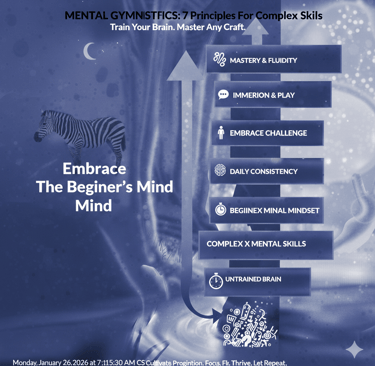
Mental training is about retraining the brain the same way physical training conditions the body. This article breaks down seven essential principles for learning complex mental skills—such as focus, writing, languages, or strategy games—by embracing beginnerhood, consistency, immersion, play, and challenge.
Derek Innes
1/26/20264 min read
Understanding Mental Training: The Brain-Body Connection
Mental training is an essential aspect of personal development that parallels physical training, where the body is conditioned for optimal performance. Just as one engages in exercises to strengthen muscles, mental training aims to enhance cognitive abilities, fostering a robust mind capable of navigating challenges efficiently. This connection between the brain and body reveals the vital role that mental skills play in overall performance in various spheres of life, including sports, academics, and personal relationships.
The neurological basis for mental training is grounded in the concept that the brain is akin to a muscle, which can be trained and strengthened over time. This perspective aligns with the notion of neuroplasticity, the brain's ability to reorganize itself by forming new neural connections throughout life. As individuals engage in mental exercises, such as visualization, goal-setting, and progressive relaxation techniques, they not only enhance their mental acuity but also improve their emotional resilience and adaptability.
Cognitive processes involved in mental training include attention, memory, and problem-solving skills. By deliberately focusing attention on specific tasks and practicing visualization techniques, individuals can improve their concentration and retention of information. Furthermore, mental training exercises often encourage the development of critical thinking and decision-making abilities, allowing individuals to approach problems with clarity and confidence.
Moreover, integrating mental training into daily routines cultivates a mindset geared towards growth and resilience. Whether one is preparing for a high-stakes performance or simply aiming to enhance everyday cognitive functions, understanding the brain-body connection is paramount for effective mental training. This foundation sets the stage for exploring essential principles that will deepen one's mastery over mental skills.
Embracing Beginnerhood: The Power of a Fresh Perspective
Adopting a beginner’s mindset can significantly enhance one’s ability to learn and grow. When individuals approach new experiences without preconceived notions or rigid expectations, they open themselves to a world of possibilities. Embracing beginnerhood encourages curiosity, creativity, and a willingness to explore uncharted territories. This mindset serves as a powerful catalyst for acquiring new skills and knowledge.
Many successful individuals have thrived by embodying the spirit of a beginner. For instance, the esteemed physicist Albert Einstein often attributed his groundbreaking insights to his ability to question established theories and maintain a relentless sense of curiosity. Similarly, the renowned artist Pablo Picasso famously stated, "Every child is an artist. The problem is how to remain an artist once we grow up." Both examples illustrate that initiating a fresh perspective allows individuals to transcend limitations and innovate.
Practical strategies for cultivating a beginner’s spirit include shifting focus from performance to learning. When engaging in a new activity, allow yourself to enjoy the process rather than fixating on results. Such an adjustment can reduce anxiety related to expectations, fostering a more profound engagement with the learning material. Furthermore, surrounding oneself with others who share a similar willingness to explore can reinforce this mindset. Joining forums, workshops, or group activities creates an environment where shared experiences further enhance learning outcomes.
Lastly, adopting a habit of reflection can provide valuable insights into one’s progress. Setting aside time to contemplate experiences reduces self-judgment and encourages self-compassion in the learning journey. As individuals embrace beginnerhood, they find that this perspective not only enriches their skill acquisition but also contributes to personal growth and development.
Consistency and Immersion: Keys to Mastery
Understanding the role of consistency and immersion in mental training is essential for those seeking to enhance their cognitive skills. The concept of consistency relates to establishing a regular practice schedule that aligns with one's goals. When individuals engage consistently in training routines, they create a structured environment that fosters progress. Research suggests that habits formed through regular practice can lead to improved neural pathways, thereby enhancing overall mental performance. This principle is particularly significant in the context of mastering complex skills or concepts, where repeated exposure contributes to retention and understanding.
Moreover, immersion is the process of fully engaging oneself in the learning environment. By immersing oneself in the subject matter, individuals can experience a deeper connection to the material, which is conducive to learning. Techniques such as active participation in exercises, utilizing supportive resources, and establishing themed environments can create immersive experiences that stimulate the mind. This approach not only makes the learning process enjoyable but also reinforces the necessary skills through experiential learning.
It is worth noting that the science of habit formation plays a pivotal role in both consistency and immersion. The brain's neuroplasticity allows for the creation and reinforcement of habits over time, thus enabling individuals to master new skills more effectively through repetitive practice. By establishing a rhythm that combines consistent practice with immersive experiences, learners can significantly enhance their mental capabilities.
In conclusion, embracing the principles of consistency and immersion is fundamental in the journey toward mental mastery. The intentional integration of these concepts into a training regime not only promotes more effective learning but also cultivates a learning mindset that thrives on active engagement and regular practice.
Play and Challenge: Enhancing Learning Through Enjoyment and Difficulty
In the realm of mental training, the concepts of play and challenge play a pivotal role in enhancing learning experiences. By incorporating elements of enjoyment and difficulty, individuals are not only more engaged but also motivated to push their boundaries, thus leading to profound growth in mental capabilities. Gamification, the process of applying game-design elements in non-game contexts, is a powerful strategy that can transform routine tasks into exciting challenges.
Engaging in play allows learners to approach problems from different angles, promoting creativity and innovative thinking. For instance, incorporating strategy games, puzzles, or interactive simulations can help individuals develop critical thinking and problem-solving skills in an enjoyable manner. These activities stimulate the brain, encouraging neuroplasticity and the ability to learn new patterns of thought. Moreover, when individuals play, they engage with content more deeply, leading to better retention and understanding.
Challenges, on the other hand, serve to stretch an individual’s mental capacity. By setting high yet achievable goals, learners are encouraged to push beyond their comfort zones. This process can occur through competitive environments, timed tasks, or progressively difficult puzzles that require both skill and strategy. Such methodologies not only foster resilience but also cultivate a growth mindset, which is crucial for consistent mental development.
In practical terms, integrating fun and challenges into mental training can be achieved through a variety of activities. For example, setting up a problem-solving escape room scenario, forming study groups that use competitive quizzes, or even simple app-based games designed for mental workouts are effective strategies that make learning enjoyable while fostering critical skills. Ultimately, by embracing both play and challenge in mental training, individuals can create a rich foundation for personal growth and mastery in their cognitive endeavors.
In conclusion, the combination of playful elements and challenging tasks is essential in enhancing the effectiveness of mental training. By implementing these principles, readers are encouraged to actively incorporate these strategies into their practices and embark on the path towards achieving mental mastery.