
Understanding Motivation: The Science Behind Sustainable Drive
Motivation isn’t mysterious or magical. It follows simple, predictable principles similar to basic physics. This article explains how inertia, energy, fear, possibility, structure, and community interact—and how to use them intentionally to motivate yourself in a sustainable way.
Derek Innes
1/26/20264 min read
The Physics of Motivation: Inertia and Energy
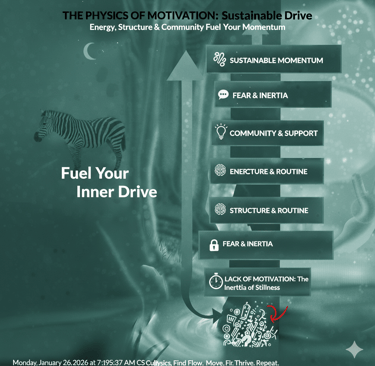
Understanding motivation through the lens of physics provides valuable insights into human behavior, particularly when considering the concepts of inertia and energy. Inertia, in a motivational context, refers to the tendency of an individual to maintain their current state of action or inaction. This phenomenon explains why habits persist over time; even when these habits become detrimental, they can be surprisingly resistant to change. The difficulty in breaking free from unproductive patterns often stems from this inertia, which can make initiating new behaviors seem overwhelming.
On the other hand, energy plays a crucial role as the driving force behind all actions. It is essential for transforming the potential to change into actual results. When sufficient energy is harnessed, individuals can effectively overcome the inertia that binds them to their current patterns. However, it is vital to recognize that energy must be directed and focused to be truly effective. A mere buildup of energy without a clear purpose can lead to frustration and inefficiency.
To utilize these concepts positively, individuals should strive to understand their personal inertia. Acknowledging the behaviors that are habitual can allow for targeted strategies aimed at fostering change. For instance, implementing small, manageable steps towards new goals can help reduce resistance and gradually build momentum. Furthermore, identifying sources of energy, whether intrinsic motivation or external encouragement, can amplify one’s capacity to break free from stagnation. Through this understanding, individuals can not only recognize the forces at play within their behaviors but also effectively manipulate them to ignite sustainable drive.
Navigating Fear and Possibility
Fear can often manifest as a formidable obstacle that impedes motivation. It is a natural emotional response that arises when individuals perceive a threat or uncertainty. However, understanding how to confront and manage these fears is essential for fostering sustainable drive. One effective approach is to reframe fear as a potential ally rather than an adversary. This shift in perspective encourages individuals to view fear through a lens of opportunity. By recognizing that fear can serve as a signal of something important on the horizon, individuals can utilize its energy to spur action rather than retreat.
Strategies such as exposure therapy, cognitive restructuring, and mindfulness can be instrumental in managing fear. Exposure therapy involves gradually confronting fears in controlled environments, which helps in desensitizing the fear response. Cognitive restructuring encourages individuals to challenge and change irrational thoughts associated with fear, fostering a more balanced outlook. Incorporating mindfulness practices allows individuals to stay rooted in the present moment, reducing the grip of fear on their motivation.
Simultaneously, it is crucial to embrace the allure of possibility as a counterbalance to fear. Focusing on potential positive outcomes can serve as a powerful motivator; envisioning success and the benefits of taking risks encourages individuals to act despite their fears. This proactive mindset shifts attention from what could go wrong to what might be achieved, fostering resilience. Setting specific, achievable goals can help bridge the gap from fear to possibility, providing a clear pathway toward action. By integrating these strategies, individuals can learn to navigate the complexities of fear and possibility, ultimately transforming obstacles into platforms for personal and professional growth.
Designing Structure for Success
The foundation of sustainable motivation lies in the structures we establish in our lives. Effective systems, routines, and environments can significantly enhance productivity and foster a consistent drive towards achieving personal and professional goals. To design a structure conducive to success, one must begin by recognizing the elements of their daily life that can be optimized.
One effective approach is to implement daily routines. A well-planned routine can eliminate decision fatigue, allowing individuals to focus their energy on tasks that matter most. This involves scheduling specific times for work, exercise, and leisure, thereby creating a balanced lifestyle that supports sustained motivation. Consistency in habits not only reinforces commitment but also serves to build momentum towards goal achievement.
In addition to routines, the environment plays a critical role in influencing motivation levels. A cluttered or chaotic space can detract from focus and productivity. Consequently, creating an organized and inspiring workspace can serve as a powerful motivator. Ensure that the environment is not only functional but also aligned with personal aesthetics, which can further enhance motivation. Personalizing the space with meaningful artifacts can evoke positive emotions, serving as a constant reminder of the goals one is striving to achieve.
Lastly, implementing effective systems, such as technology tools and organizational methods, can streamline tasks and reduce overwhelm. Utilizing applications for task management, establishing clear priorities, and setting periodic reviews can facilitate a productive workflow. These systems help track progress, making it easier to stay motivated through measurable achievements and adjustments.
By consciously designing structures within daily routines, environments, and systems, individuals can cultivate an atmosphere that supports their aspirations, enhancing sustainable motivation over time. Building these integral parts will pave the way for achieving consistent progress in any endeavor.
The Power of Community and Support
Motivation can often be perceived as an individual endeavor, yet the significance of community and support in fostering a sustainable drive cannot be understated. Engaging in relationships with like-minded individuals can provide essential accountability, inspiration, and encouragement, creating a dynamic network that nurtures motivation. When individuals are surrounded by supportive peers or mentors, the motivation to pursue goals intensifies through shared experiences and mutual reinforcement.
A community fosters a sense of belonging and connection, which plays a pivotal role in maintaining motivation. When individuals share their aspirations and challenges with others, they become part of a collective journey. This shared understanding often leads to increased commitment, as group members inspire one another to stay focused and overcome obstacles. Additionally, the diversity found in a community can introduce new perspectives and ideas, igniting creativity and driving enthusiasm towards goal attainment.
Moreover, building a network of support can offer practical benefits. Engaging with others allows individuals to exchange resources, advice, and strategies that may assist in overcoming hurdles. For example, participation in workshops, forums, or local clubs targeting specific interests can amplify one’s resolve by forming connections that lead to collaborative efforts. Social motivation, whether in professional circles or personal pursuits, revitalizes the pursuit by making the journey enjoyable and fulfilling.
To cultivate one’s community, individuals can start by identifying shared goals and finding platforms that encourage interaction, be it online or offline. Regular participation, open communication, and contributing to others’ efforts can solidify these relationships, establishing an encouraging environment that celebrates achievements and fosters resilience. In essence, leveraging the supportive nature of community provides the encouragement necessary to sustain motivation in the long run.