
The Art of Getting Good: Mastering Skills Through Play, Focus, Immersion, and Feedback
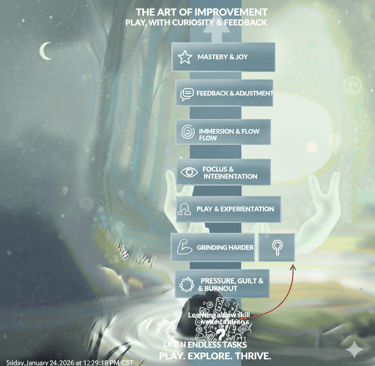
Getting good is not about grinding harder or waiting for motivation. It is about play, focus, immersion, and feedback. This post breaks down a practical approach to improvement that works across skills, sports, learning, and life.
Derek Innes
1/24/20264 min read
Introduction
In the pursuit of success, there exists a widespread belief that hard work and motivation are the primary drivers behind mastery. Many individuals adhere to the notion that relentless grinding and waiting for moments of inspiration is the formula for achieving their goals. This common mindset is often perpetuated by success stories that emphasize the power of determination. However, this perception can significantly oversimplify the complexities of skill development and may lead to counterproductive strategies.
When people focus solely on hard work, they may overlook essential elements that contribute to effective learning and improvement. In many cases, the emphasis on effort without the incorporation of practical methods can result in burnout, frustration, and stagnation. Consequently, individuals might find themselves trapped in an endless cycle of exertion, where progress remains elusive despite their dedication.
Emerging research in the fields of psychology and education suggests a more nuanced approach. Instead of merely grinding harder, engaging in skill acquisition through avenues such as play, focus, immersion, and constructive feedback can lead to superior outcomes. Such a paradigm shift recognizes that learning can be an enjoyable and fulfilling process rather than a monotonous chore.
By framing skill development within this context, we open ourselves up to new strategies that can facilitate genuine improvement. Emphasizing play and immersion invites a refreshing perspective that encourages exploration and discovery, rather than relentless pressure. The role of focus aids in directing attention towards essential components of skill enhancement, while timely feedback ensures that learners can adjust and refine their methods effectively.
This blog post will further explore these themes, showcasing how adopting a balanced approach to mastery can lead to enriched experiences and sustainable growth in one's chosen endeavors.
The Role of Play in Skill Development
Play serves as a fundamental avenue for skill development and learning across various domains. Engaging in playful activities encourages individuals to explore, experiment, and innovate, which contributes significantly to the mastery of new skills. Rather than solely relying on structured learning methods, incorporating play can enhance the overall educational experience by fostering creativity and reducing the anxiety often associated with high-stakes learning environments.
In the sphere of sports, for example, many athletes credit their success to early experiences in playful settings. Children who participate in unstructured play often develop better coordination, strategy, and teamwork, which are vital for sports. A study involving youth hockey players revealed that those who participated in informal games improved their skills more rapidly compared to those who practiced solely through rigid drills. These playful interactions not only build skills but also instill a lifelong love for the game, making them more likely to persist in their athletic pursuits.
Similarly, in the arts, play manifests in various forms such as improvisation in theater or exploration of new mediums in visual arts. Artists often engage in playful experimentation without the fear of failure, leading to groundbreaking works. For instance, the renowned painter Pablo Picasso emphasized the importance of retaining the qualities of a child in his art, demonstrating how play influences creativity and innovation. By allowing oneself to play freely, artists can break traditional boundaries and develop unique styles that ultimately enrich their craft.
Educational environments also benefit from the integration of play. Techniques such as gamification and interactive learning have shown promising results in enhancing student engagement and knowledge retention. By transforming complex concepts into playful challenges, educators can create conducive learning environments that stimulate curiosity and learning. Ultimately, the incorporation of play into skill development processes not only enhances competence but also cultivates a deeper passion for learning.
Focusing and Immersion: The Keys to Effective Practice
In the pursuit of mastering any skill, the roles of focus and immersion cannot be overstated. Achieving a state of deep focus facilitates learning, enabling individuals to retain and apply new information effectively. To cultivate this focus, one must begin by setting clear, achievable goals. These goals serve as a road map, providing direction that minimizes distractions and allows for concentrated effort. Furthermore, creating an environment conducive to focus is essential; this can include eliminating visual and auditory distractions, ensuring a clutter-free workspace, and allocating specific times dedicated to practice.
The concept of 'flow,' popularized by psychologist Mihály Csíkszentmihályi, refers to a mental state where individuals become fully immersed in an activity, leading to enhanced performance and satisfaction. Achieving flow during practice involves balancing challenge and skill level. If the task is too easy, boredom sets in; if it is too challenging, anxiety can arise. Therefore, it is important for practitioners to adjust their difficulty levels to find that critical sweet spot.
Techniques to promote immersion include engaging in regular practice sessions while maintaining consistency in time and effort. Incorporating mindfulness techniques can also aid in centering one’s thoughts, allowing practitioners to focus exclusively on the task at hand. Tools such as timers can help structure practice sessions, ensuring that individuals commit wholly to skill development without succumbing to distractions. In essence, developing the ability to focus deeply and immerse oneself in practice not only enhances skill acquisition but also fosters a gratifying experience conducive to learning.
The Power of Feedback: Learning from Experience
Feedback plays a crucial role in the process of skill development, serving as a fundamental mechanism through which individuals can identify their strengths and weaknesses. Constructive feedback provides insight into areas that require improvement, facilitating a targeted approach to honing one’s skills. By understanding how feedback can enhance performance, individuals can embrace it as a valuable component of their growth journey.
There are various sources of feedback that individuals can leverage in their learning process. Self-assessments allow practitioners to reflect on their own performance critically, enabling them to recognize patterns in their actions and outcomes. This form of introspective feedback fosters a deeper awareness of personal capabilities, laying the groundwork for subsequent improvement initiatives.
In addition to self-assessments, seeking external feedback is a foundational element of skill enhancement. Colleagues, mentors, and coaches can provide valuable perspectives that may not be visible from an individual’s eye. External critiques often uncover blind spots in performance, revealing aspects that require attention. Furthermore, engaging with others can foster collaborative learning, where individuals gain insights from shared experiences and constructive discussions.
Effectively utilizing feedback is as important as obtaining it. Individuals can adopt a proactive approach by being open to criticism and viewing it as an opportunity for growth rather than a negative judgment. Active listening and reflection on the feedback received can transform external critiques into actionable wisdom. By implementing the suggestions received, individuals can strategically refine their skills over time, enhancing their competence in their chosen domain.
In conclusion, the cycle of acquiring feedback, internalizing it, and applying learned lessons is vital for effective skill mastery. Embracing the feedback process ensures continuous improvement and fosters an adaptive learning mindset that significantly contributes to personal and professional development.