
Simplicity in Productivity
When productivity gets complicated, it stops working. This post breaks down why simple systems outperform complex tools—and how reducing friction, focus, and noise can dramatically increase both output and calm.
Derek Innes
1/19/20263 min read

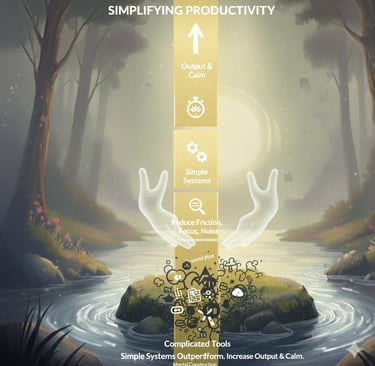
I used to be a productivity junkie.
New apps. New systems. New frameworks promising clarity, speed, and control.
And for a while, that chase felt productive.
But over time, something became obvious: the more complicated my productivity system became, the more overwhelmed I felt. Instead of doing the work, I was managing the work. Instead of focusing, I was configuring.
These days, when I feel overloaded or behind, I don’t reach for a smarter system.
I reach for simplicity.
Simple tools. Simple rules. Simple focus.
And counterintuitively, this is when I get the most done.
Complexity Feels Productive — Simplicity Is Productive
Complex systems create the illusion of control. They feel sophisticated. They make us feel like we’re “on top of things.”
But complexity comes with costs:
More decisions
More maintenance
More cognitive load
When your brain is already tired, adding more structure doesn’t help—it exhausts you.
Simplicity does the opposite. It reduces friction. It calms the nervous system. And a calmer mind executes better.
Here are a few simple practices I return to whenever productivity starts to feel heavy.
Pen and Paper (or One Notes App)
When everything feels urgent and overwhelming, I abandon whatever productivity tool I’ve been experimenting with and open a blank page.
Nothing fancy.
I write a Today list.
Not a master plan. Not a life roadmap. Just today.
The rule is simple: keep it short. If everything matters, nothing does. A short list gives clarity and relief almost instantly.
This single step often reduces overwhelm more than any app ever has.
The 3 Most Important Tasks Rule
Most days, we vastly overestimate how much meaningful work we can do.
In reality, we can usually complete about three important things well.
So I choose three.
These are not “nice to haves.” They’re the tasks that move something forward—work, life, health, or relationships. Everything else becomes optional.
When priorities are clear, productivity stops feeling chaotic. You know what matters. You stop negotiating with yourself all day.
Single-Tasking as a Default
When I feel scattered, I switch into one-thing-at-a-time mode.
One screen.
One task.
One conversation.
This isn’t just a productivity technique—it’s a quality-of-life upgrade.
Single-tasking turns work into something calmer and more deliberate. You can apply it to anything: writing, washing dishes, walking, listening to someone speak.
Multitasking fragments attention. Single-tasking restores it.
Focus Sessions
Focus works best when it’s contained.
I regularly use focus sessions—set a timer, choose a task, and commit fully until the timer ends. No checking. No switching.
Sometimes this happens with others (co-working, shared accountability). Sometimes it’s just me, a timer, and music.
The structure is minimal, but the impact is significant. Focus becomes something you enter, not something you chase.
Limits Create Freedom
One of the most powerful simplicity tools is intentional limits.
Limits remove decision fatigue.
Examples:
Only 3 MITs
One task at a time
5 minutes of social media
One episode, not three
Limits feel restrictive at first—but they actually create space. When you don’t have to decide endlessly, energy returns.
Distraction-Free Tools
When possible, I choose tools that get out of the way.
Distraction-free writing apps.
Site blockers.
Clean reading tools.
The goal isn’t optimization—it’s absence of noise. The fewer choices an app presents, the easier it is to stay with the work.
Walking: The Original Productivity Hack
When focus breaks down completely, I walk.
No podcast. No phone.
Just movement and thinking.
Walking clears mental clutter and restores perspective. Some of my best ideas don’t arrive at my desk—they arrive five minutes into a walk.
Simple Beats Perfect
Most productivity struggles aren’t caused by laziness or lack of discipline.
They’re caused by systems that are too heavy for real life.
We keep searching for the perfect setup, when what we actually need is a lighter one.
Simplicity isn’t primitive.
It’s precise.
And when productivity feels hard, simpler is usually better.