
Resilience Is a Skill—Not a Personality Trait
Setbacks are inevitable. What matters is how quickly and cleanly you return to forward motion. This post explains what resilience actually is and how to build it through practical, repeatable practices.
Derek Innes
1/19/20263 min read

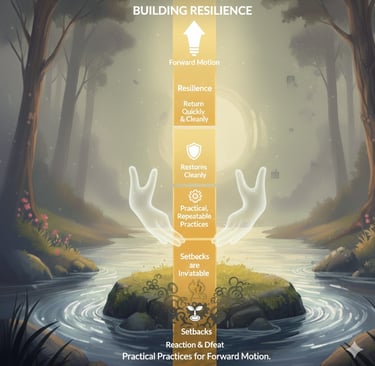
If you commit to anything long enough—building a habit, pursuing a goal, changing your life—you will be disrupted.
You’ll have off days.
You’ll lose momentum.
You’ll miss commitments.
You’ll feel discouraged, frustrated, or unsure whether it’s worth continuing.
This is not a sign you’re doing it wrong.
It’s a sign you’re doing something real.
The question is never whether you’ll be knocked off course.
The question is whether you know how to get back into motion when it happens.
That ability is resilience.
What Long-Term Resilience Really Means
Resilience isn’t brute strength or emotional toughness.
It’s not about pushing harder, ignoring discomfort, or forcing yourself through resistance.
Resilience is the ability to:
Absorb difficulty without collapsing into self-judgment
Accept disruption without overreacting
Return to your center and re-engage with clarity
It’s the confidence—earned through practice—that you can handle whatever shows up and continue forward.
Resilience isn’t something you either have or don’t have.
It’s a capacity you develop.
Why Most People Struggle After Setbacks
Setbacks themselves aren’t the real problem.
What derails people is the meaning they assign to them.
A missed habit becomes proof of failure.
A delay becomes evidence you’re behind.
A bad day becomes a reason to doubt the entire effort.
This interpretation creates unnecessary weight.
Resilient people experience the same setbacks—but relate to them differently.
The Mindset Shifts That Build Resilience
Resilience begins with how difficulty is framed.
Here are the shifts that matter most:
Setbacks
Instead of seeing them as signs something is wrong, see them as part of the terrain. Every worthwhile path includes obstacles.
Failure
Failure isn’t a verdict—it’s information. It shows you what didn’t work and points toward what might.
Timelines
Most timelines are invented. Progress doesn’t unfold on schedule—it unfolds through cycles of advance, disruption, and return.
Emotions
Frustration, discouragement, doubt, and fatigue aren’t indicators to quit. They’re natural responses to challenge. They are meant to be felt, not eliminated.
Starting Again
Starting over isn’t a flaw in the process—it is the process. Mastery is learning to restart without drama.
The more quickly and calmly you can restart, the more resilient you become.
How Resilience Is Built in Practice
Insight alone doesn’t build resilience. Practice does.
Here are foundational practices that strengthen it over time:
1. Regulate Before You Respond
When you notice discouragement or frustration, start with the body.
Pause.
Slow your breathing.
Relax tension.
A calm nervous system restores perspective.
2. Practice Acceptance Without Giving Up
Acceptance means ending the fight with reality—not approving of it.
Missed days happen.
Energy dips happen.
Life interferes.
Acceptance removes the added suffering that keeps you stuck.
3. Let Emotions Move Through You
Avoiding emotions makes you more fragile.
Resilience grows when you allow emotions to be felt as physical sensations—without judgment or analysis.
They pass more quickly when they’re not resisted.
4. Restart Small and Clean
After disruption, don’t compensate. Restart gently.
Open the document.
Take five minutes.
Begin again.
Small restarts rebuild momentum faster than grand recommitments.
5. Use Support Intentionally
Resilience strengthens in connection.
Community, accountability, coaching, or therapy reduce isolation and normalize struggle. You don’t become resilient by doing everything alone.
6. Choose Meaning Deliberately
You can’t always control setbacks—but you can choose their meaning.
Instead of asking:
“Why does this keep happening?”
Ask:
“What is this teaching me?”
Meaning transforms difficulty into growth.
The Long View
Resilience isn’t about bouncing back quickly or perfectly.
It’s about:
Recovering with less self-criticism
Restarting with less delay
Responding with more steadiness
Each repetition strengthens the skill.
You don’t avoid setbacks.
You get better at returning.
Final Thought
You don’t need a flawless plan or constant motivation.
You need a reliable way back into motion when things fall apart.
Build that capacity slowly.
Practice it consistently.
Trust it when things get hard.
That’s the art of resilience.