
Navigating Emotional Triggers: A Practical Guide for Human Response
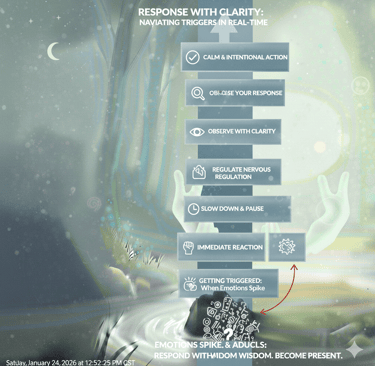
Getting triggered is part of being human. This practical guide walks you through what to do in the moment when emotions spike, helping you slow down, regulate your nervous system, and respond with clarity instead of reaction.
Derek Innes
1/24/20264 min read
Understanding Emotional Triggers
Emotional triggers are stimuli that evoke strong emotional responses, often rooted in past experiences or deeply held beliefs. These triggers can be specific words, actions, or even environments that catalyze feelings ranging from anger and sadness to joy and fear. The significance of emotional triggers lies in their ability to elicit reactions that may not always be proportionate to the stimulus, highlighting how past experiences shape our emotional landscape.
The human experience is characterized by a broad emotional spectrum that encompasses various feelings. Emotional triggers can arise unexpectedly, leading individuals to react in ways that seem disproportionate or confusing. For instance, a seemingly innocuous comment might provoke feelings of anger if it resonates with a past trauma or conflict. Understanding this mechanism is crucial in navigating one’s emotional responses effectively.
Triggers are also influenced by societal norms and personal values. Cultural background and social upbringing can shape what individuals find distressing or comforting, leading to a complex interplay of emotions that vary from person to person. Awareness of the source of these triggers enables individuals to comprehend their reactions better and engage in productive coping strategies. It is essential to recognize that feeling triggered is a universal aspect of being human, rather than an anomaly. By acknowledging this reality, individuals can foster more profound emotional awareness and resilience.
In summary, emotional triggers are an integral part of human psychology. They emerge from a combination of personal history, societal influences, and individual values. Understanding their psychological significance not only aids in personal growth but also facilitates better interactions with others.
The Science of the Nervous System
The human nervous system plays a crucial role in regulating our responses to emotional triggers. When an event occurs that evokes a strong emotional sensation, our body initiates a series of physiological changes, primarily through the activation of the sympathetic nervous system. This activation is best exemplified by the well-known fight-or-flight response, a survival mechanism that prepares the body to either confront or escape from perceived threats.
Upon experiencing an emotional trigger, our brain processes the information and signals the release of stress hormones, such as adrenaline and cortisol. These hormones prompt a variety of bodily changes: heart rate accelerates, blood pressure rises, and energy is redirected to essential muscles, all of which enhance our ability to respond quickly to a stressful situation. Furthermore, blood flow is diverted from non-essential functions, which can also lead to feelings of anxiety or discomfort.
Understanding how our nervous system functions can empower us to better navigate our emotions during triggering situations. For instance, recognizing that our fight-or-flight response is a natural reaction enables us to approach these circumstances with greater awareness. Techniques such as deep breathing, mindfulness, and grounding exercises can help mitigate the intensity of this response, allowing for a more measured approach to emotional stimuli. By recognizing our physiological signals and understanding their origins, we can foster emotional resilience and regain control over our reactions.
Moreover, integrating this knowledge into daily practices can transform the way we approach challenges. Developing skills to understand and manage the natural responses of our nervous system can significantly enhance our emotional intelligence, ultimately leading to healthier interpersonal interactions and improved mental well-being.
Strategies for Regulation in the Moment
Emotional triggers can evoke overwhelming feelings that lead to impulsive reactions. However, there are several practical techniques that individuals can implement to help regulate their emotions effectively at the moment they arise. One of the most effective methods is deep breathing exercises. By focusing on slow, deep breaths, individuals can activate their parasympathetic nervous system, which calms the body and mind. For example, inhaling deeply through the nose for a count of four, holding the breath for a count of four, and then exhaling slowly through the mouth for a count of four can create a sense of tranquility, allowing for a more measured response to the triggering situation.
Grounding techniques are another handy strategy that promotes emotional regulation. These methods help anchor individuals to the present moment, diverting attention from distressing thoughts and feelings. One popular technique involves the "5-4-3-2-1" method, where one identifies five things they can see, four things they can touch, three sounds they can hear, two smells they can identify, and one movement they can feel. This exercise not only serves as a distraction but also assists in cultivating awareness of one's surroundings, which facilitates emotional stabilization.
Mindfulness practices are pivotal in managing emotional responses. By engaging in mindfulness meditation or simply taking a moment to reflect, individuals can observe their thoughts and feelings without judgment. This practice encourages a non-reactive stance toward emotional triggers and cultivates an awareness of sensations in the body. Placing emphasis on the present can foster a deeper understanding of oneself, which is essential for effective self-regulation. Incorporating such methods into daily life can empower individuals, providing them with actionable strategies that can help navigate emotional challenges with greater ease.
Responding with Clarity: Communicating Effectively
In situations where an emotional trigger has occurred, it is imperative to respond with clarity to foster a constructive dialogue. Effective communication allows individuals to express their feelings and experiences in a manner that promotes understanding, rather than escalating the situation. The first step in this process is self-regulation, which involves taking a moment to calm oneself before addressing the issue. This could mean practicing deep breathing, counting to ten, or even stepping away for a brief period to collect thoughts.
Once a level of calm has been achieved, articulating feelings becomes essential. Use "I" statements to express emotions associated with the trigger. For example, saying "I feel overwhelmed when meetings run overtime" provides context without assigning blame. It is crucial to be specific about what triggered the feeling, as this aids in creating a shared understanding with others involved. Additionally, avoid using accusatory language, which can lead to defensiveness and hinder productive conversation.
Engaging in reflective dialogue involves active listening and empathy. During this phase, it is important to validate others' feelings, acknowledging their perspective even if it differs from your own. Paraphrasing their statements can confirm that you are actively listening. For instance, stating, "I hear you saying that you felt unheard during our last discussion" can promote a sense of connection and openness. Moreover, outlining mutual goals can guide the conversation toward resolution, emphasizing that the aim is to reach an understanding rather than to win an argument.
Ultimately, the goal of responding with clarity is to navigate emotional triggers in a way that facilitates healing and growth. By expressing oneself appropriately and engaging in reflective dialogue, individuals can strengthen relationships and encourage emotional resilience.