
How to Clear a Procrastination Backlog
Avoided tasks don’t disappear—they accumulate. This post outlines a simple, low-pressure system for reducing a procrastination backlog using clarity, small action, and momentum instead of willpower.
Derek Innes
1/19/20262 min read

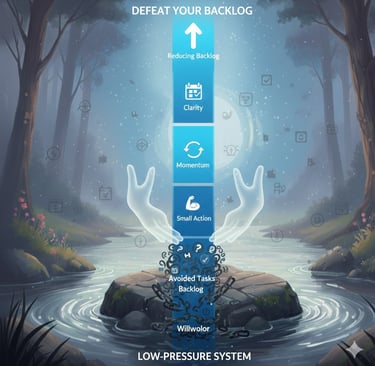
Procrastination doesn’t usually come from laziness.
It comes from emotional weight.
Tasks we avoid don’t just sit there—they press on us. The longer they remain untouched, the heavier they feel. Eventually, even opening the list creates resistance.
The goal isn’t to eliminate procrastination forever.
It’s to reduce the backlog to a manageable size and keep it there.
Step One: Create Clarity Without Overwhelm
Avoidance thrives in vagueness.
So start by writing a short, honest list of the things you’ve been putting off. Not everything you should do—just the items that carry mental weight.
Put the easiest items near the top.
This isn’t about courage or toughness.
It’s about lowering the barrier to starting.
When the list is visible and finite, action becomes possible.
Step Two: Make Starting Almost Too Easy
Big time blocks create pressure. Pressure fuels avoidance.
Instead, work in short, defined bursts.
Set a timer for 15 minutes.
Choose one item—any item—from the top of the list.
Start.
If it takes two minutes, move to the next one.
If it takes longer, stop when the timer ends.
Then pause. Reset. Acknowledge progress.
The only goal of these sessions is movement, not completion.
Step Three: Turn Progress Into a Game
Seriousness slows momentum.
Playfulness sustains it.
Treat backlog-clearing like a short-term challenge:
One to five short sessions per day
Gradually increase duration if it feels natural
Focus on consistency, not heroics
Each completed task gets crossed off.
Each session counts as a win.
After a week, stop and mark the progress. Even partial reduction matters.
Step Four: Repeat Until the Weight Is Gone
Backlogs rarely disappear entirely—and they don’t need to.
Over one or two focused weeks, most people can reduce theirs to a level that no longer drains attention.
Once the pressure drops, action becomes easier.
That’s the real objective.
How to Keep the Backlog From Returning
Maintenance matters more than elimination.
A simple rhythm helps:
Create a short weekly list
Prioritize the most important items
Review what didn’t get done
If something keeps rolling over week after week, it goes back onto the focused list and gets intentional attention.
Short sessions. Clear scope. No drama.
The Core Insight
You don’t clear procrastination by demanding motivation.
You clear it by:
Reducing emotional friction
Making starting easier
Replacing avoidance with small, repeatable action
Backlogs shrink when pressure does.
Progress follows.