
Form New Routines Without Burning Out
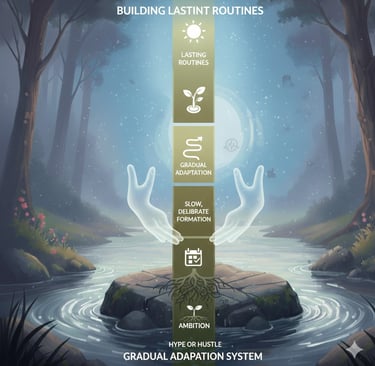
Lasting routines aren’t built through ambition—they’re built through gradual adaptation. This post explains why slow, deliberate habit formation works and how to create routines that actually stick.
Derek Innes
1/19/20261 min read

Most routines fail for a simple reason:
We try to change everything at once.
The motivation is sincere. The plan is ambitious. And within a week, the routine collapses under its own weight.
This isn’t a discipline problem.
It’s a pacing problem.
Why Gradual Change Works
Humans don’t adapt instantly. We adjust through repetition and familiarity.
When routines demand too much, too fast:
Resistance increases
Consistency drops
The habit feels heavy instead of helpful
Gradual change avoids that trap by keeping effort below the threshold where avoidance kicks in.
Small steps feel manageable.
Manageable steps get repeated.
Repetition builds routines.
The One-Change Rule
The most reliable way to form routines is to introduce one small change at a time.
Not a full overhaul.
Not a perfect schedule.
Just one adjustment your nervous system can accept without pushback.
Once that step feels normal, you add the next.
A Practical Example
Imagine you want a stronger morning routine that includes reflection, movement, and focused work.
Instead of doing everything immediately, you build it in layers:
Week 1: Wake up 15 minutes earlier and sit quietly or meditate
Week 2: Wake up another 15 minutes earlier and add short journaling
Week 3: Add a brief movement or stretching practice
Week 4: Introduce focused creative or thinking time
Each habit starts in its smallest usable form.
No strain. No pressure. No all-or-nothing thinking.
After a month, you’ve created a meaningful routine—without ever forcing it.
Why This Approach Succeeds
Gradual routines:
Lower psychological resistance
Reduce decision fatigue
Build confidence through consistency
Survive low-motivation days
You’re not relying on willpower.
You’re designing for sustainability.
The Long-Term Advantage
When routines feel natural instead of demanding, they persist.
You stop “trying” to do them.
They simply become part of how your day starts or ends.
That’s the goal—not intensity, but integration.
A Final Prompt
What’s one small routine you could begin this week—small enough that it feels almost too easy?
Start there.
Then build.