
Find Your Center When You’re Riled Up
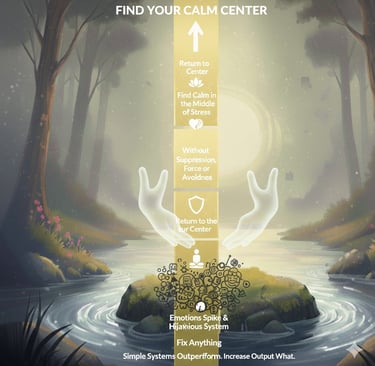
When emotions spike and your nervous system feels hijacked, you don’t need to fix anything. You need to return to your center. This post shows how to find calm in the middle of stress—without suppression, force, or avoidance.
Derek Innes
1/19/20262 min read

Most days, there’s a moment when something knocks us off balance.
A comment lands the wrong way.
A situation doesn’t go as planned.
Stress accumulates quietly—until it doesn’t.
Suddenly you’re riled up: anxious, irritated, frustrated, reactive.
When this happens, the instinct is usually to do something—argue, distract, fix, escape. But the fastest way back to clarity isn’t action.
It’s finding your center.
What “Finding Your Center” Really Means
Finding your center doesn’t mean becoming emotionless or calm on command.
It means reconnecting with the steady place underneath the turbulence—the calm that exists even while emotions are active.
Think of it like the center of a storm. The winds may be violent around the edges, but at the core there’s stillness.
That stillness is always available. You don’t create it—you return to it.
Step One: Notice Without Judgment
The practice starts with awareness.
Notice that you’re riled up.
That’s it.
No analysis. No fixing. No story about why it’s happening. Just recognition.
This step alone matters more than most people realize. When you notice instead of react, you’ve already shifted out of autopilot.
And remind yourself: this is normal. Emotional turbulence is part of being human, not a failure of control.
Step Two: Create a Small Container of Space
If possible, step away from stimulation.
Go outside.
Sit in a quiet room.
Create even a few minutes of physical separation.
You’re not running away—you’re giving your nervous system room to reset.
Step Three: Sit With the Sensation
Sit in stillness for a few minutes.
Bring attention to the physical sensation of being riled up. Not the story—just the body experience.
For many people, this shows up in the chest, stomach, or shoulders. Tightness. Heat. Pressure.
Let it be there.
Don’t try to push it away. Don’t dramatize it. Just notice it as sensation and allow it to exist.
This is crucial: resistance keeps turbulence active. Allowing it lets it unwind.
Step Four: Widen Your Awareness
Now gently expand your attention outward.
Notice the space around your body.
The sounds in the room.
The feeling of air, light, or gravity.
As awareness widens, something subtle happens: the turbulence stops being the center of attention.
You begin to feel spaciousness—a quiet, open awareness that isn’t tense or urgent.
This spaciousness is your center.
Step Five: Let Settling Happen Naturally
Stay here for a few minutes.
You don’t need to force calm. You don’t need to resolve anything.
Often, the turbulence will settle on its own—like sediment sinking in a glass of water when it’s no longer shaken.
Sometimes it doesn’t fully settle—and that’s OK too. The goal isn’t perfection. It’s reconnection.
Why This Works
This practice works because it interrupts reactivity without suppressing emotion.
You’re not fighting feelings.
You’re not indulging them either.
You’re changing your relationship to them.
When emotions are allowed and awareness is widened, the nervous system regulates itself.
Return to the Center, Again and Again
Finding your center isn’t a one-time achievement.
It’s a practice you return to—sometimes many times in a single day.
Each return builds capacity.
Each pause reduces reactivity.
Each moment of spaciousness restores perspective.
You don’t need to wait for calm to begin.
Calm is already there—waiting for you to come back to it.