
Breaking Free: The Power of Full Commitment in Overcoming Stagnation
Feeling stuck often comes from hesitation, doubt, and staying in a holding pattern. This article explains how a single, full commitment can cut through complexity, restore momentum, and create forward movement across many areas of life.
1/26/20264 min read
Understanding the Feeling of Being Stuck
Experiencing a sense of stagnation is common in today's fast-paced world. Many individuals report feeling stuck in various aspects of their lives, including personal relationships, career paths, and emotional well-being. This state often arises from a complex interplay of hesitation, self-doubt, and fear of change. When individuals encounter these barriers, they may find themselves at a standstill, unsure of how to move forward.
Hesitation often stems from a lack of clarity about one's desires or goals. When faced with uncertainty, many people experience heightened levels of anxiety and reluctance to make active choices, leading to inertia. This indecision can manifest in numerous ways, from procrastination in pursuing career advancements to avoidance of meaningful conversations in personal relationships. Consequently, those feeling stuck frequently perceive their days blending together, lacking purpose or direction.
Moreover, self-doubt acts as a debilitating force that can disrupt progress. It erodes confidence and heightens the fear of failure, making it difficult to take the necessary steps toward change. This internal conflict can result in a negative feedback loop, where the absence of action reinforces feelings of inadequacy and helplessness. Emotional distress can spread, creating an adverse impact on mental health, often culminating in anxiety or depression.
Identifying the symptoms of feeling stuck is crucial for moving towards resolution. Recognizing the signs, such as persistent dissatisfaction, a sense of aimlessness, or a repeating pattern of missed opportunities, can shed light on the underlying issues. By understanding these emotions and psychological factors, individuals can begin to confront their feelings of stagnation and work towards breaking free from the constraints that impede personal growth and fulfillment.
The Complexity of Hesitation and Doubt
In the realm of decision-making, hesitation and doubt often introduce a significant degree of complexity, leading individuals to grapple with mental barriers that hinder progress. This internal conflict creates a paradox where the fear of commitment can outweigh the desire for change. Individuals may find themselves caught in a web of uncertainty, resulting in prolonged deliberation over choices that ultimately leads to stagnation.
One critical aspect of this complexity is the overthinking that frequently accompanies difficult decisions. When faced with multiple paths, individuals can become paralyzed by the potential outcomes, scrutinizing each choice meticulously. The escalation of doubt can distort the perceived risks and benefits, amplifying concerns and leading to a cognitive spiral that complicates what could otherwise be straightforward choices.
Recognizing these mental barriers is a crucial first step toward breaking free from indecision. Individuals are encouraged to acknowledge their fears surrounding commitment, which often stem from a deeper desire for safety and security. By reframing thoughts around commitment, one can simplify the decision-making process. Emphasizing commitment as an opportunity for growth rather than a potential pitfall can significantly alter the approach individuals adopt toward their choices.
Strategies to overcome hesitation include setting clearer goals, which can provide a framework for assessing options more effectively. Additionally, limiting the amount of information gathered about each option could reduce the impact of overthinking. A commitment to action, even in the face of uncertainty, allows individuals to navigate complexities with greater confidence. Ultimately, addressing the intricacies of hesitation and doubt is essential in fostering an environment where commitment becomes a catalyst for personal and professional growth.
The Power of a Full Commitment
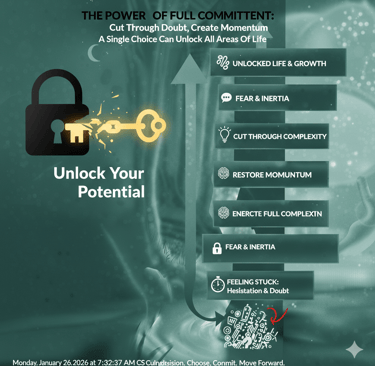
In the journey of personal growth, the concept of full commitment stands as a pivotal catalyst for overcoming feelings of stagnation. By making a decisive commitment to a specific goal or change, individuals can ignite a powerful transformation that not only propels them forward but also reinstates clarity in their life’s direction.
The benefits of such commitment are manifold. First, it brings about a restoration of momentum. When an individual wholeheartedly commits to a course of action, it creates a sense of urgency and focus. This urgency functions as a driving force that helps propel one out of complacency. Moreover, full commitment often leads to a reduction in indecision, thereby freeing up cognitive resources to concentrate on productive tasks.
Numerous examples of individuals and groups illustrate the remarkable impact of full commitment. Consider the case of a corporate team that faced declining performance due to a lack of direction. Upon realizing the necessity for change, the team collectively committed to adopting a new strategic plan. This decisive step not only enhanced their productivity but also rejuvenated team morale. With a clear goal in mind, the group not only improved their performance metrics but experienced an uplift in collaboration and innovation.
Another compelling example can be seen in personal health transformations. Individuals who commit fully to a lifestyle change, such as adopting a healthier diet or engaging in regular exercise, often report significant improvements in both physical and mental well-being. This commitment acts as a foundation for building resilience, fostering a supportive community, and establishing lasting habits that contribute to a fulfilling lifestyle.
In essence, the power of full commitment serves as a unique tool in overcoming stagnation. It enables individuals and groups to transcend barriers, restore lost momentum, and propel themselves toward a clearer purpose.
Creating Forward Movement: Steps to Take After Commitment
Once an individual has made the pivotal decision to fully commit to their goals, the journey toward overcoming stagnation truly begins. To translate commitment into action, it is crucial to set actionable and specific goals. These goals should be broken down into manageable tasks, allowing for a step-by-step approach toward progress. For instance, rather than stating a vague intention to "improve skills," one might specify to "dedicate 30 minutes each day to practicing a new language." This clarity provides direction and enhances motivation.
Maintaining focus is another essential aspect of this journey. With distractions abundant in today’s fast-paced world, it is imperative to create an environment conducive to productivity. This may involve organizing a dedicated workspace, minimizing digital distractions, or allocating specific times for focused work. This deliberate structuring of one's environment can significantly enhance one’s ability to concentrate and engage with the tasks at hand.
Additionally, resilience plays a vital role in the path to progress. Setbacks and challenges are inevitable; however, viewing them as opportunities for learning and growth is critical. When faced with difficulties, individuals should take time to reflect on what can be learned rather than succumbing to frustration. This mindset shift not only fosters perseverance but also empowers individuals to adapt their strategies as necessary, reinforcing the notion that growth may not always be linear.
Building a supportive network can further propel movement forward. Engaging with mentors, peers, or support groups can provide encouragement and accountability. Sharing progress and challenges with others can facilitate constructive feedback and celebrate milestones, boosting morale and fostering ongoing commitment to the journey ahead. Leverage these relationships to inspire resilience and a sustained push toward your goals.