Balancing Long Term Improvement with Short Term Happiness
Improving your life does not require sacrificing your happiness today. This post explores a practical way to align long term growth with short term enjoyment, so progress and pleasure can coexist rather than compete.
Derek Innes
1/22/20262 min read
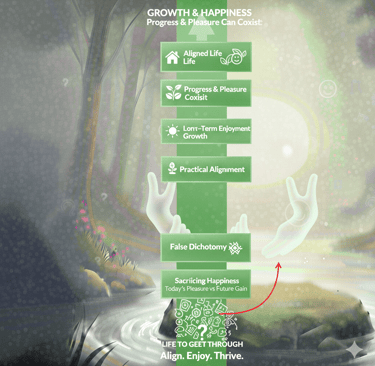
One of the most common struggles in personal growth is the tension between long term improvement and short term happiness.
On one hand, there are actions that clearly support your future. Exercising, studying, writing, working on meaningful projects, managing your finances. On the other hand, there is the very human desire to relax, watch something easy, eat comfort food, or simply switch off.
It often feels like a choice. Either you do what is good for your future or you enjoy yourself right now. Either discipline or pleasure. Either effort or ease.
Framed this way, growth starts to feel like deprivation. And enjoyment starts to feel like self sabotage.
There is another way to approach this, one that does not force you to choose between the two.
Take the Long View
The first step is to zoom out.
Rather than making decisions based purely on impulse, it helps to ask what kind of life you want to be building over time. Not in vague or idealized terms, but in practical ones. What do you want your days to support five or ten years from now?
For many people, this includes health and energy, meaningful work, learning and growth, and strong relationships. When you clarify what truly matters in the long run, it becomes easier to see which actions are investments rather than chores.
This does not mean denying yourself enjoyment. It means letting long term values guide most decisions, while still allowing room for rest and pleasure.
Find the Repeatable Actions
Once you have a sense of what you want to build, the next step is identifying the small, repeatable actions that move you in that direction.
These are not dramatic transformations. They are ordinary behaviors practiced consistently. Daily movement. Eating mostly nourishing food. Focused work sessions. Regular connection with people you care about.
These actions often compete with short term urges. Distraction is easier than focus. Comfort is easier than effort. This is where many people struggle, not because they lack willpower, but because the actions feel like sacrifices.
This is where the approach usually breaks down.
Learn to Love the Process
The real shift happens when you stop treating long term actions as something to endure and start treating them as something to enjoy.
Instead of viewing healthy eating as restriction, you can learn to enjoy foods that genuinely make you feel good. Instead of forcing yourself through workouts you dislike, you can choose forms of movement that feel playful or satisfying. Instead of grinding through work, you can bring curiosity, creativity, or a sense of service into what you are doing.
Almost any activity can be made more enjoyable when you bring intention to how you experience it. Attention, curiosity, and play change the texture of effort.
This does not mean every moment becomes blissful. Some actions will still be challenging. But when you find ways to appreciate the process, progress stops feeling like a trade off.
When you enjoy the actions that support your future, long term improvement and short term happiness stop being opposites. They become part of the same path.
Growth does not have to come at the cost of joy. When you align what you do today with what you want tomorrow, and learn to take pleasure in those actions, you build a life that feels good now and later.