
An Instant Technique for Greater Calm
Most stress doesn’t come from what’s happening—it comes from the story we’re telling about it. This simple, instant technique helps you step out of mental construction and return to calm in seconds, even in the middle of pressure.
Derek Innes
1/19/20263 min read

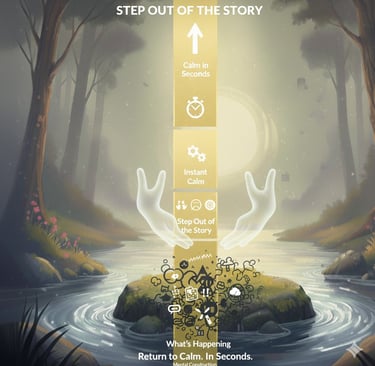
Lately, I’ve been practicing a remarkably simple technique that reduces stress, frustration, and overwhelm almost immediately. It doesn’t require fixing the situation, changing other people, or thinking more positively.
It works by interrupting the mental story we’re living inside.
The practice is influenced by Buddhist thought, particularly the idea that the “separate self” we experience—this sense of being a fixed individual battling a hostile world—is largely a mental construction. We experience life through interpretations, not raw reality.
And those interpretations are powerful.
Stress Is Constructed, Not Discovered
Most of what we experience as stress isn’t the event itself—it’s the meaning we attach to it. We build a narrative in our heads and then react to that narrative as if it were fact.
Consider a few common examples:
Someone offers feedback, and it lands as criticism. The mind quickly decides: They always judge me. Frustration follows. But that interpretation is only one possibility. The same moment could also be understood as a request, a misunderstanding, an attempt to help, or an expression of their own stress.
Or imagine an upcoming meeting. The presentation isn’t even finished yet, but the anxiety is already active. The mind predicts rejection, embarrassment, or failure. In response, we either overprepare to exhaustion or avoid the work entirely. But the reactions of others—and what they might “mean”—exist only in imagination.
Or take habit change. You miss a few days of eating well or exercising, and suddenly the story becomes personal: I’m inconsistent. I’m failing. I’m not disciplined enough. But that meaning is invented. The missed days could just as easily indicate fatigue, unrealistic expectations, or the simple difficulty of change.
In each case, the suffering isn’t caused by the event. It’s caused by the interpretation.
And interpretations are created.
If It’s Created, It Can Be Released
This doesn’t mean your experience is fake or invalid. Emotions are real. Reactions are real. But the story shaping them is something the mind assembles—often automatically, often without our awareness.
That’s important, because anything constructed can also be softened, reframed, or set down.
Which brings us to the technique.
The Instant Technique
The practice itself is intentionally simple:
1. Notice the stress.
The first requirement is awareness. You can’t interrupt what you don’t notice. Pay attention to the moment you feel tension, anxiety, frustration, or overwhelm.
2. Name the construction.
Silently say a single word: “Imaginary.”
(You can use a different word if you prefer.)
This isn’t meant to dismiss your feelings. It’s a reminder that the world you’re reacting to—the predictions, judgments, assumptions, and meanings—is being generated in your mind.
3. Let the story loosen.
By labeling the experience as imagined, you create distance. The grip softens. You stop taking the narrative so seriously. Space opens.
In that space, something surprising happens.
What Remains When the Story Drops
When the mental construction fades—even briefly—what’s left isn’t chaos or emptiness.
It’s the present moment.
Without the imagined future, the replayed past, or the self-judging narrative, the moment is often calm. Neutral. Sometimes even quietly beautiful.
There may still be sound, movement, sensation—but no threat. No urgency. No problem to solve immediately.
Peace isn’t created in that moment. It’s revealed.
And this shift doesn’t take hours of meditation or deep analysis. It can happen in seconds—right in the middle of a difficult day—if you remember to notice and name the story.
Calm Is Closer Than You Think
You don’t need to eliminate stressors or control outcomes to feel calmer. You only need to recognize when you’ve entered a constructed mental world and gently step out of it.
Say the word.
Create space.
Return to the moment.
Calm isn’t something you earn.
It’s what’s already here when the story lets go.