
A Guide to Getting Better at Taking Action
Taking action sounds simple, but overwhelm, fear, and self doubt often stop us before we begin. This guide breaks down how to build the skill of action through simplicity, nervous system regulation, self trust, and encouragement.
Derek Innes
1/24/20262 min read
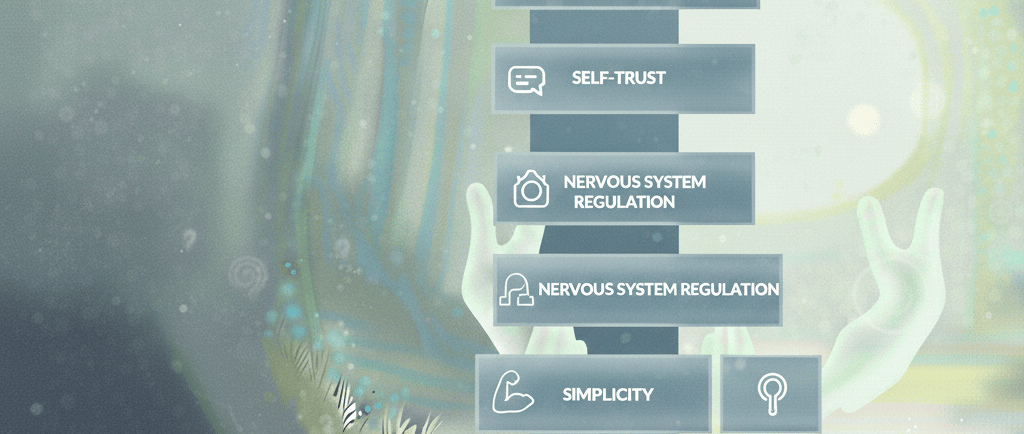
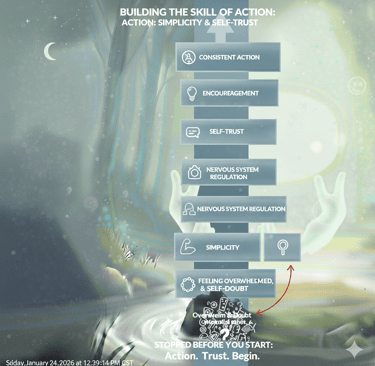
Here’s a cleaner, more grounded long-form version with better flow, stronger rhythm, and no symbols or dividers. Same ideas, just sharper and more confident.
The idea of taking action can feel both inspiring and exhausting at the same time. We want to move forward, change habits, and get our lives in order, yet many of us feel behind before the day even starts. Long mental lists follow us everywhere, whispering what we should be doing. When everything feels urgent, action stops feeling possible.
So how do we actually get better at taking action?
This is not a willpower problem. It is not a discipline problem. It is a skill problem. Taking action is a trainable life skill, and like any skill, it improves with the right kind of practice. The practices themselves are simple, but they require consistency. If you are willing to commit to them for a month or two, you will begin to notice real change.
Everything starts with simple action.
Most people get stuck in one of two ways. They either think about everything they need to do and shut down under the weight of it all, or they focus on a single complicated task with too many decisions and freeze. Both reactions are human. Both make sense. And both prevent movement.
The way out is simplicity.
One action at a time.
As small as possible.
If a task has ten steps, your only job is the first one. If a decision feels heavy, practice choosing simply instead of perfectly. Choose, act, and trust that clarity will come later. Momentum does not come from flawless planning. It comes from movement.
Making a list helps contain the chaos.
Write down the things you are avoiding. Not to criticize yourself, but to bring them into the open. These are the tasks carrying emotional weight, the ones quietly draining your energy.
Each day, choose one or two items from the list, or take a very small bite out of one. If something feels too big, do only the first step. When that step is done, stop. Let that be enough for the day.
Progress comes from returning tomorrow, not from finishing everything today.
Learning to breathe and trust yourself is essential.
At some point, you will feel the urge to escape. This is not failure. It is your nervous system reacting to perceived threat. The practice is not to push harder, but to pause. Breathe more deeply. Slow down. Let your body settle.
When you feel a little steadier, ask yourself a powerful question.
How would I act right now if I completely trusted myself?
Then act from that place, even if the trust feels shaky. Trust is not something you wait for. It is something you build through action.
Encouragement changes everything.
Most people sabotage action with harsh self talk. This is too hard. This is pointless. I am bad at this. I will mess it up. When that is the inner dialogue, giving up feels reasonable.
Practice encouragement instead.
Notice every small action.
Acknowledge it.
Be proud of it.
Simple phrases like nice work, keep going, or you showed up today reinforce momentum. Encouragement is fuel. Without it, action dries up.
Support accelerates growth.
Taking action on your own is possible, but doing it with structure and accountability makes it far more sustainable. If you want guidance and support, consider joining my five day program for deeper training in the Positivity frameworks.
Action is not about pushing harder.
It is about reducing friction.
Simplify.
Breathe.
Trust.
Encourage.
Repeat.
That is how taking action becomes natural.